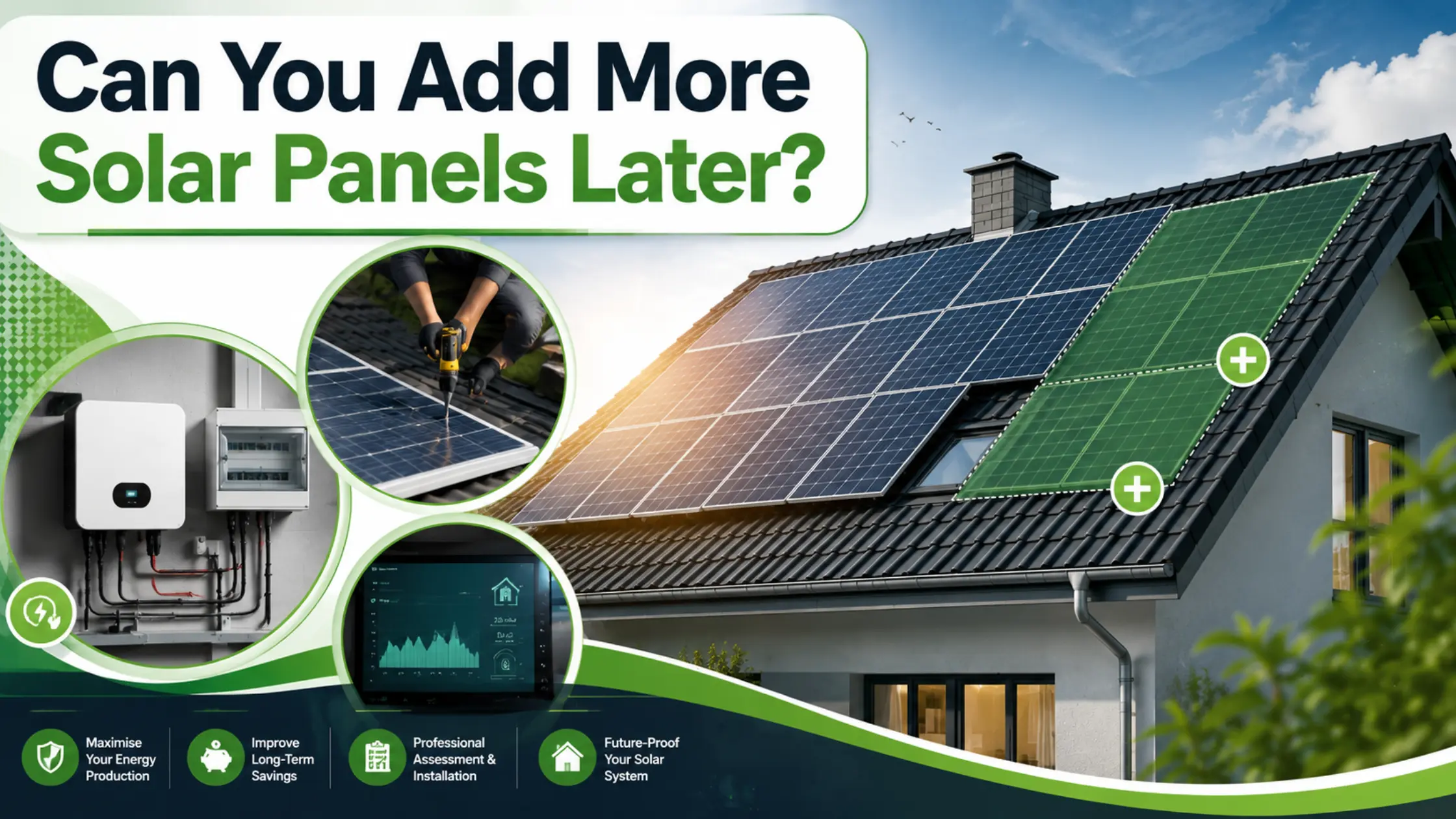
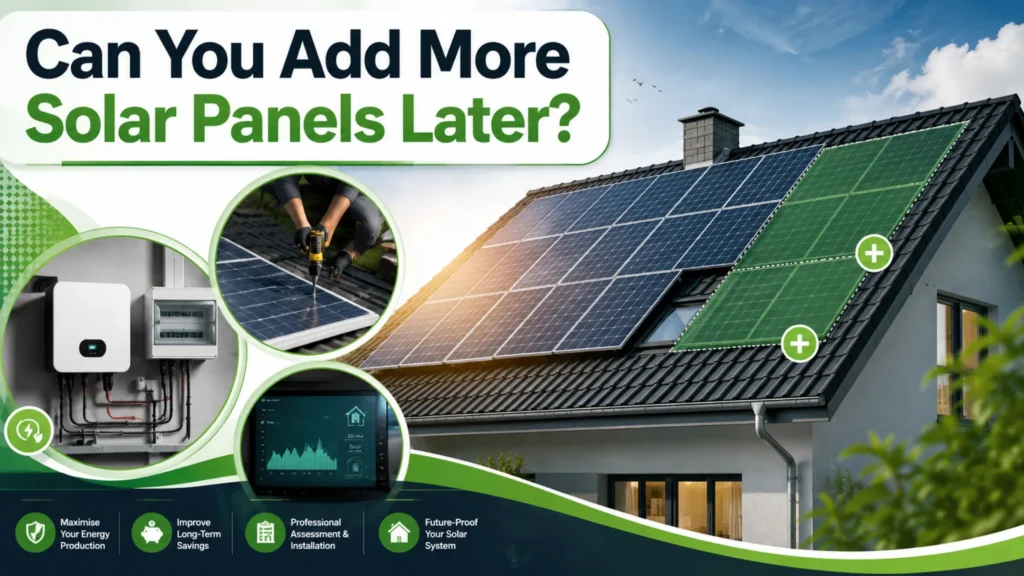
It is one of the most common questions we hear from homeowners who started with a smaller system. The short answer is yes, but whether it is straightforward depends entirely on how your original system was designed.
Here is what you need to know before assuming it is a simple bolt-on job.
Why Homeowners Want to Expand
Most expansion requests come down to one of three reasons.
- Energy consumption has increased, usually from adding an EV or a heat pump
- Generation is not covering as much of the bill as expected
- Roof space was deliberately left unused at installation with expansion in mind
All three are valid, and all three lead to slightly different approaches.
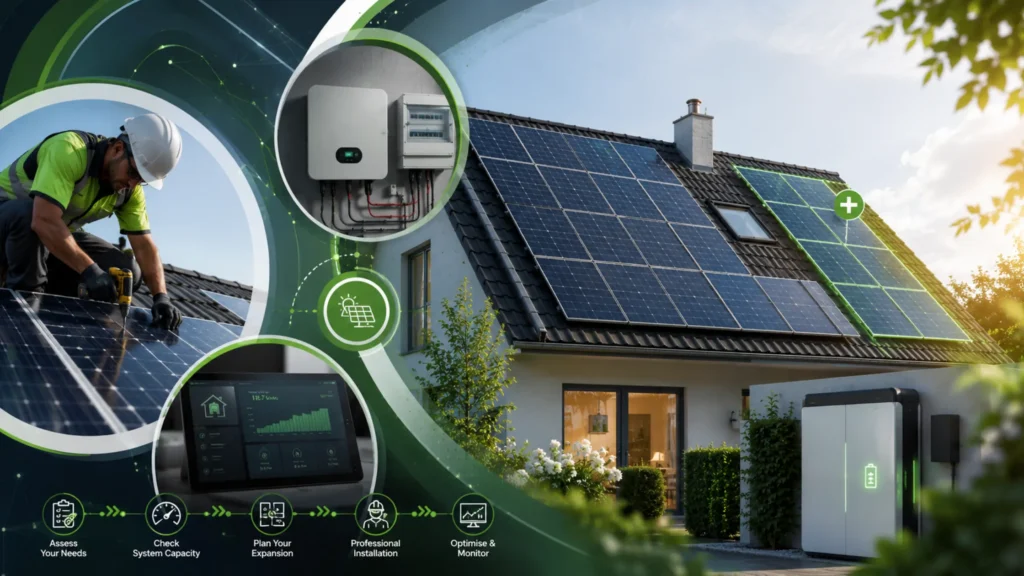
The First Question: Can Your Inverter Handle More Panels?
This is the most important question, and most homeowners do not think to ask it.
Every inverter has a maximum DC input rating. Adding panels beyond this limit does not create more generation. It either damages the inverter or triggers protective shutdowns.
Most residential inverters have some headroom above the existing array size. Whether yours does depends on the original specification. What is a solar inverter and why do you need one? explains how inverter capacity works and why it matters.
A qualified engineer can confirm your headroom within minutes by checking your inverter datasheet against your current array output.
What If Your Inverter Is Already at Capacity?
You have three options.
Replace the inverter with a larger model that handles the expanded array. This gives you a clean, fully integrated system.
Add a second inverter to run the additional panels independently. This is common on larger properties and avoids disrupting the existing setup.
Install a separate system entirely with its own inverter, which can connect to a battery or diverter independently.
Each option has different costs and implications. A site survey will clarify which makes most sense for your property.
Roof Space and Mounting Considerations
Structural Load
Adding panels adds weight. Most UK roofs handle standard solar loads comfortably, but if your roof has had previous structural issues, an assessment before expanding is worthwhile.
Shading Changes
A roof that had minimal shading when originally surveyed may have more now due to tree growth or new buildings nearby.
Solar panels and shading explains why a fresh shading analysis before expanding is worth doing, particularly if several years have passed since the original installation.
Mixing Old and New Panels
Adding different panels to an existing string is possible but not always advisable.
Panels with different power ratings or temperature coefficients perform differently under the same conditions. On a string inverter system, this drags performance toward the weakest panel.
The cleaner solution is adding new panels on a separate string. If your system uses micro inverters or optimisers, the issue largely disappears as each panel operates independently. Inverter or micro inverter explains how panel-level independence changes the expansion equation.
DNO Notification for Expanded Systems
Adding panels is a change to a notified system and requires updated DNO notification.
If your original system was notified under G98, expanding it may push total capacity above the G98 threshold, requiring a G99 application instead. Installing additional panels without updating your DNO notification puts you in breach of your grid connection agreement and can affect your export tariff eligibility.
Understanding G98, G99 and G100 explains the thresholds and what each notification level involves. Your installer handles this as part of the expansion, but it is not optional.
MCS Certification for Expanded Systems
Any expansion must be carried out by an MCS-certified installer.
A new or updated MCS certificate must be issued for the complete system. This is required to maintain Smart Export Guarantee eligibility on the full expanded array. Uncertified work on a certified system can also affect your existing warranties.
Is Expanding Always the Right Answer?
Not always. Before committing to more panels, consider this.
Adding battery storage to a system that is already exporting significant surplus often delivers better financial returns than more panels. A battery captures generation you are currently exporting at low SEG rates and uses it at full electricity price value instead.
Home battery storage covers how to assess whether battery or panel expansion is the better next step for your specific setup. A qualified installer can model both options against your current generation and consumption data.
What Does Solar Panel Expansion Cost?
| Expansion Scenario | Typical Cost Range |
| Additional panels, inverter has headroom | £800 to £2,000 |
| Additional panels, inverter replacement required | £2,000 to £4,000 |
| Additional panels, second inverter added | £2,500 to £4,500 |
| Separate second system with battery | £4,000 to £8,000+ |
A site survey and inverter capacity check will confirm which scenario applies to your property.
Conclusion
Adding more solar panels is possible in most cases, but the right approach depends on your inverter’s headroom, roof space, and whether expanding panels actually delivers better value than adding battery storage. Getting an MCS-certified engineer to assess your existing system before committing is the most important first step.
Frequently Asked Questions
Can I add panels to any existing solar system?
In most cases yes, but the approach depends on your inverter’s remaining capacity and available roof space. A site survey confirms what is possible before any commitment is made.
Do I need a new MCS certificate if I expand my system?
Yes. Any expansion must be carried out by an MCS-certified installer and a new or updated certificate issued for the complete system to maintain Smart Export Guarantee eligibility.
Can I mix old and new panels on the same system?
It is possible but not recommended on string inverter systems where mismatched panels reduce overall performance. A separate string for new panels, or a system using micro inverters, avoids this issue.
Will adding panels affect my export tariff?
Only if the expansion changes your DNO notification category. Your installer should handle the updated DNO notification as part of the expansion. Failing to update it can put your export tariff eligibility at risk.
Is battery storage a better investment than more panels?
For systems already generating significant surplus, battery storage often delivers better returns than additional panels. A qualified installer can model both options against your current generation and consumption data to confirm which makes more financial sense.