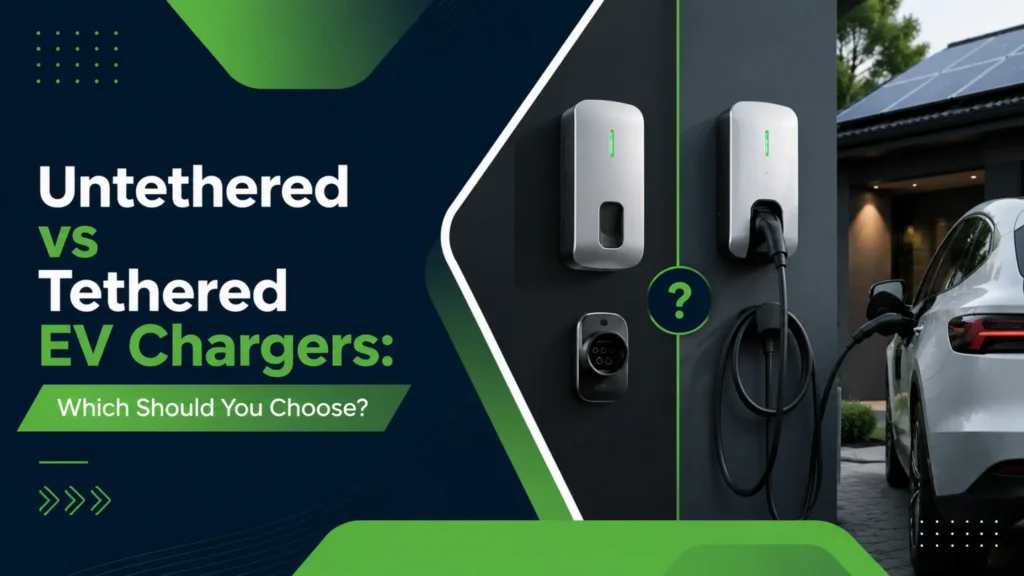
Choosing between a tethered and untethered EV charger is mainly a question of day-to-day convenience, cable storage and the vehicles you need to charge. The cable arrangement itself does not determine charging speed: on otherwise equivalent equipment, speed depends on the charger rating, your electrical supply, the vehicle’s onboard charger, the cable rating and any load-management or solar-charging settings.
For homes in Edinburgh and the Lothians, the best choice also depends on where you park, the distance from the charger to the vehicle inlet and whether you want to use surplus energy from solar PV.
What is a tethered EV charger?
A tethered charger has a charging cable permanently attached to the unit. You unwind the cable, plug it into the car and return it to the charger after use.
Most current UK tethered home chargers use a Type 2 vehicle connector, which suits the great majority of modern UK EVs. The main advantage is convenience: the cable is always at the charging point and cannot be left in the boot or elsewhere.
What is an untethered EV charger?
An untethered charger, also called a socketed charger, has a Type 2 socket instead of a fixed cable. You connect a separate, compatible Mode 3 charging cable between the unit and the vehicle each time you charge.
This can leave the wall unit looking tidier when it is not in use and lets you replace the cable independently if your required length or vehicle connection changes. It also means handling and storing the cable, and the correct cable may need to be purchased separately.
Tethered vs untethered: side-by-side comparison
| Consideration | Tethered charger | Untethered charger |
|---|---|---|
| Daily use | Cable is always attached and ready | Connect and disconnect your own cable |
| Appearance | Cable remains at the unit and needs to be coiled neatly | Cleaner appearance when the cable is stored away |
| Cable choice | Length and connector are set by the charger model | You can choose a compatible cable and length |
| Compatibility | Check the fixed connector suits every vehicle you plan to charge | Type 2 socket provides flexibility when used with the correct Mode 3 cable |
| Cost | Varies by product and cable length | Varies by product; allow for a separate cable if needed |
| Best suited to | Drivers prioritising quick, simple daily connection | Drivers prioritising a tidy unit or replaceable cable |
Does tethered or untethered affect charging speed?
Not by itself. A tethered and an untethered version of the same charger can deliver the same maximum power when both are installed and used correctly. The actual charging rate is limited by the lowest-rated part of the system, including:
- the chargepoint’s power rating;
- whether the property has a single-phase or three-phase supply;
- the vehicle’s AC onboard-charger limit;
- the rating of a detachable cable;
- dynamic load management and the available capacity at the property; and
- the selected smart, tariff or solar-charging mode.
Many UK homes use a charger of around 7 kW on a single-phase supply. Higher-power AC charging is only useful where the supply, installation and vehicle can support it. A site survey should confirm the appropriate specification rather than assuming the cable style dictates performance.
Connector and cable compatibility in the UK
Type 2 is the standard connection for current UK domestic AC chargepoints. Government residential chargepoint specifications require a Type 2 socket where a socket outlet is used and Mode 3 charging equipment. Older vehicles with a Type 1 inlet need particular attention when selecting the charger and cable.
A portable Mode 2 cable, sometimes called a granny charger, is not the cable used between a socketed wall chargepoint and an EV. An untethered wall unit needs a compatible Mode 3 cable with the correct connectors and current rating.
CCS and CHAdeMO refer primarily to DC rapid-charging connections. They do not replace the need to check the vehicle’s AC inlet for home charging.
Cable length, parking and safe positioning
Tethered cable lengths vary by manufacturer and model, so measure the real route from the proposed charger position to the vehicle inlet before ordering. Allow for different parking directions and any second EV you may use.
An untethered unit lets you select a suitable cable length separately, but the cable should never be routed where it creates a trip hazard or crosses a public pavement without an approved solution. For Edinburgh terraces, shared parking areas and more complex driveways, charger location can matter more than the tethered-versus-untethered decision.
Can both types work with solar panels?
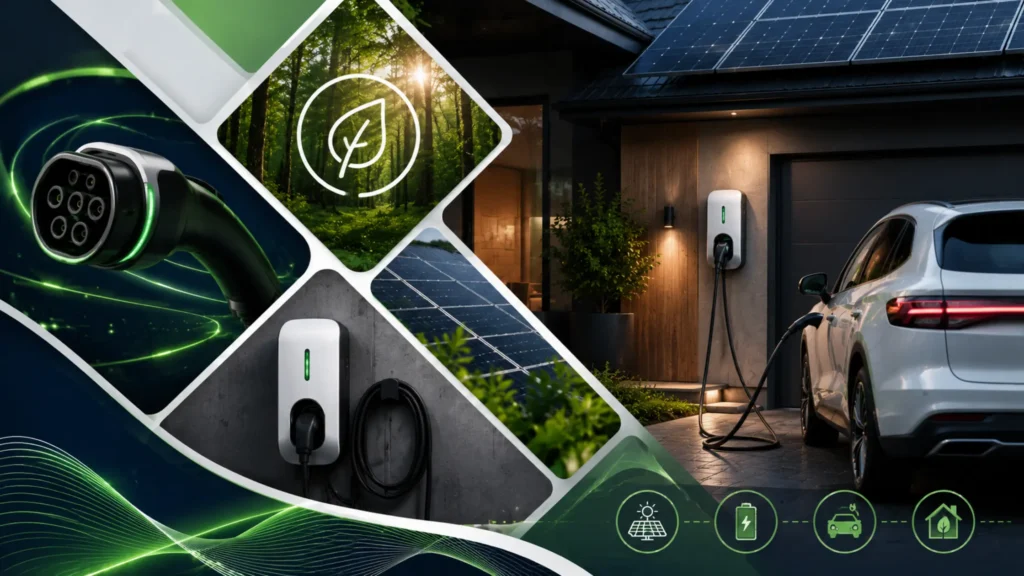
Yes, provided you select a charger with suitable solar-integration features. Tethering is simply the cable arrangement; it does not decide whether a charger can monitor household generation and use surplus solar power.
For example, myenergi offers compatible zappi models in tethered and untethered configurations. The right setup depends on the charger model, monitoring equipment, solar array, household demand and vehicle charging behaviour. See our EV charging point installation service for the options we assess during a home survey.
Which option should you choose?
Choose a tethered charger if you value the fastest possible plug-in routine and are happy to keep the fixed cable neatly stored on the unit. It is often the simplest option for a household whose vehicles all use a compatible Type 2 connection.
Choose an untethered charger if you prefer a cleaner-looking wall unit, want to select or replace the cable separately, or need flexibility for a less common vehicle inlet. For a two-EV household, either can work when both cars are compatible; electrical capacity, load balancing and parking layout are usually more important than whether the cable detaches.
There is no universal winner. Compare specific charger models, included cable lengths, warranty terms, smart features and the installed price. Renew-Able can survey homes across Edinburgh and the Lothians and recommend a compliant setup based on the property, vehicles and any solar PV or battery system. Explore all our renewable-energy services or request an EV charger assessment.
Frequently asked questions
Does a tethered EV charger charge faster than an untethered charger?
No. On equivalent equipment, the cable arrangement does not set charging speed. The charger rating, electrical supply, vehicle’s onboard charger, cable rating and load-management settings determine the actual rate.
Do I need my own cable for an untethered home charger?
Yes. You need a compatible Mode 3 charging cable with the correct vehicle connector and current rating. Check whether one is supplied with the car or charger before comparing total costs.
Can a tethered charger be converted to untethered later?
It depends on the product, but many chargers are sold as distinct tethered or socketed models and are not designed for a simple user conversion. Ask the manufacturer or an approved installer before modifying any chargepoint.
Which type is best for a home with two EVs?
Either can work if both vehicles are compatible. An untethered unit offers more cable flexibility, while a tethered unit is quicker to connect. The property supply, load balancing, parking positions and required number of chargepoints should be assessed as part of the design.
Can tethered and untethered chargers both use surplus solar power?
Yes, when the selected charger and monitoring setup support solar charging. Tethered versus untethered describes the cable connection and does not determine solar compatibility.