
Edinburgh is one of the windiest cities in the UK, and it is one of the first questions homeowners ask before committing to solar. The short answer is yes, but the full answer depends on how your panels are specified, mounted, and installed.
Here is what every Edinburgh homeowner should know before going solar.
How Windy Is Edinburgh Really?
Before looking at what panels can handle, it helps to understand what they are actually up against in Edinburgh.
According to the Met Office, Edinburgh averages wind speeds of around 13 mph, with gusts regularly exceeding 50 mph during autumn and winter storm events. The city’s position on the east coast of Scotland, combined with its exposed hillside topography, means properties in areas like Corstorphine, The Pentlands, and Portobello face significantly higher wind loads than the UK average.
If you are exploring solar panel installation in Edinburgh, wind loading is a site-specific calculation that should be part of every professional assessment.
How Solar Panels Are Built to Handle Wind
Modern solar panels are engineered specifically to withstand severe weather, and the standards they are tested against are stricter than most people realise.
IEC 61215 Wind Load Testing
Every reputable solar panel sold in the UK is tested to IEC 61215, the international standard for crystalline silicon photovoltaic modules. This standard requires panels to withstand a static wind load of 2,400 Pa, which is equivalent to wind speeds of approximately 130 mph.
For context, the most severe storm gusts recorded in Edinburgh have not come close to this threshold, meaning the panels themselves are rarely the weak point in a wind event.
Frame and Glass Construction
Modern panels use aluminium frames and toughened tempered glass designed to flex slightly under load without cracking. The frame absorbs and distributes wind pressure across the panel rather than concentrating stress at any single point. Premium panel manufacturers such as SunPower, REC, and Panasonic publish specific wind resistance ratings that exceed the IEC minimum, which matters for Edinburgh’s more exposed rooftops.
Degradation and Long Term Resilience
Repeated wind loading over many years does not significantly degrade a well-manufactured panel. What it can do is gradually loosen mounting hardware if the installation is not checked periodically. Solar panel maintenance including torque checks on mounting bolts is particularly important for Edinburgh properties that experience frequent high-wind events.
Where Wind Damage Actually Happens
Panel glass rarely fails in the wind. The real vulnerability in most wind-related solar incidents is the mounting system and the roof beneath it.
Mounting System Failures
The most common cause of wind damage to solar installations is mounting failure, not panel failure. If rails, clamps, or roof fixings are undersized, incorrectly spaced, or installed without proper structural assessment, wind uplift can detach panels or the entire array from the roof.
British Standard BS 5534 governs the fixing of slating and tiling in the UK and provides the framework for calculating wind uplift loads, and any MCS-certified installer should be applying these calculations as standard.
Roof Structure Compatibility
Wind loads from a solar array are transferred directly into your roof structure. If the underlying timbers, rafters, or tiles are in poor condition, a wind event can cause damage that would not have occurred without panels fitted.
A structural survey of your roof before installation is not optional on Edinburgh properties, it is essential. The correct mounting system for your roof type makes a significant difference to how wind loads are distributed and absorbed.
Incorrect Tilt and Panel Spacing
Panels installed at the wrong angle or without adequate gap spacing between the array and the roof surface can create a wind sail effect, where air pressure builds underneath the panels and generates significant uplift force. MCS installation standards specify minimum clearances and tilt angles that account for this, and deviating from them increases wind risk considerably.
Flashing and Roof Penetrations
Every roof penetration made during installation is a potential weak point in high winds if not sealed and flashed correctly. Poorly sealed entry points for mounting bolts and cable routes allow water ingress during wind-driven rain, which is a near-constant feature of Edinburgh winters. Over time this causes timber rot and structural weakening that compounds the wind risk.
What a Good Edinburgh Solar Installation Looks Like
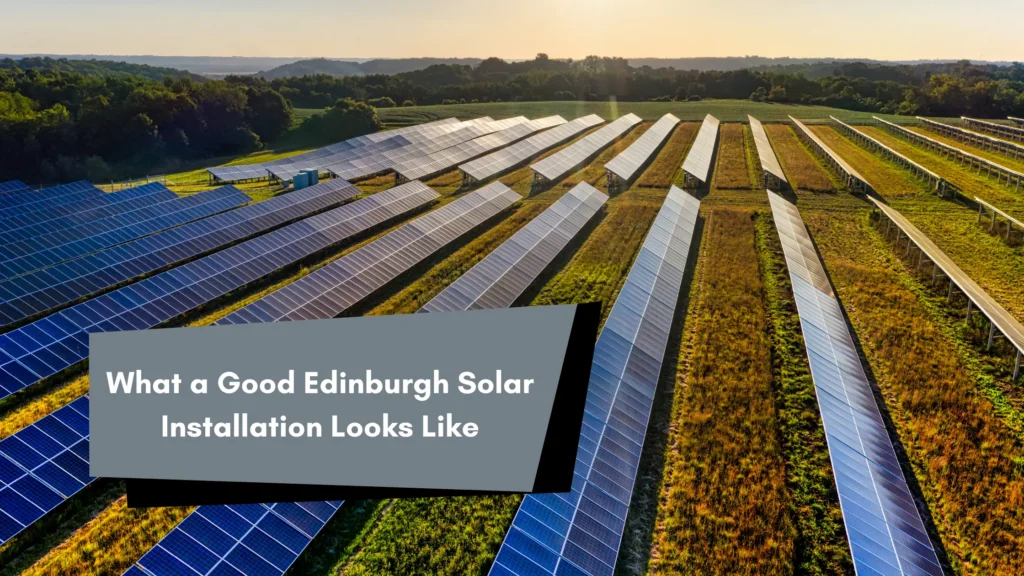
A correctly specified installation accounts for Edinburgh’s wind conditions at every stage, from site assessment through to the final fixing torque.
Site-Specific Wind Load Calculations
Your installer should calculate the wind load for your specific postcode and roof orientation using BS EN 1991-1-4, the Eurocode for wind actions on structures. This is not a generic figure. A property on an exposed south-facing slope in the Pentlands carries a very different wind load to a sheltered north Edinburgh terrace. Installers who quote without a site visit and structural assessment are skipping this step.
MCS-Certified Installation Standards
MCS certification requires installers to follow the MCS 012 installation standard, which includes specific requirements for wind load assessment and mounting system design. Using an MCS-certified installer is the single most reliable way to ensure your system is specified correctly for Edinburgh’s conditions. You can verify any installer’s MCS status at mcscertified.com.
Panel Orientation and Array Design
The best angle for solar panels in the UK balances generation output with structural considerations. On exposed Edinburgh rooftops, slightly reducing the tilt angle can meaningfully reduce wind uplift forces while having a minimal impact on annual generation. A good installer will model both factors and recommend the optimal configuration for your property.
Post-Installation Checks
After any significant storm, it is worth visually checking your array for shifted panels, loose clamps, or displaced roof tiles around the mounting points. Most wind-related issues start small and are easily fixed if caught early. Solar energy performance in Scottish weather can also help you identify if a wind event has affected generation output before it becomes visible on the roof.
Does Wind Actually Help Solar Panels?
This surprises many homeowners but wind has a positive effect on solar panel performance.
Solar panels lose efficiency as they heat up, and their operating temperature is one of the key factors affecting real-world output.
Wind cools panels naturally, keeping them closer to their rated operating temperature and improving efficiency. In Edinburgh’s climate, where summer temperatures rarely cause panels to overheat significantly, wind is more of a benefit than a risk for well-installed systems.
Winter generation from solar panels is often better than homeowners expect partly because cooler, windier conditions keep panels operating efficiently.
Conclusion
Solar panels are built to handle far more wind than Edinburgh ever throws at them. The risk is not the panels themselves but the mounting system, the roof structure beneath them, and the quality of the installation.
A professionally designed, MCS-certified installation that accounts for Edinburgh’s specific wind load conditions will perform reliably for 25 years or more.
If you are unsure whether your existing system was installed to the right standard, an inspection by a qualified engineer will give you a clear picture.
Frequently Asked Questions
What wind speed can solar panels withstand?
Solar panels tested to IEC 61215 are rated to withstand static wind loads equivalent to approximately 130 mph. Storm gusts in Edinburgh have not exceeded this threshold, so panel glass failure from wind alone is extremely rare.
Do solar panels increase the risk of roof damage in high winds?
A correctly installed system does not increase wind risk and can actually reinforce the roof surface it is mounted on. The risk comes from poor installation, inadequate mounting hardware, or fitting panels to a roof that was already in poor structural condition.
Should I take my solar panels down before a storm?
No. Roof-mounted solar panels are fixed installations and are not designed to be removed for weather events. If your system was installed correctly to MCS standards, it will handle Edinburgh’s storm conditions without intervention.
How do I know if my mounting system is strong enough?
Ask your installer for the wind load calculation specific to your property and check that it references BS EN 1991-1-4. If your system was installed by an MCS-certified installer following MCS 012 standards, this calculation should already be part of your installation documentation.
Can wind noise from solar panels be a problem?
Mild whistling or vibration noise during high winds is occasionally reported on installations where panel clearance above the roof is insufficient or where clamps are loose. An annual service check will identify and resolve any fixings that have shifted over time.